
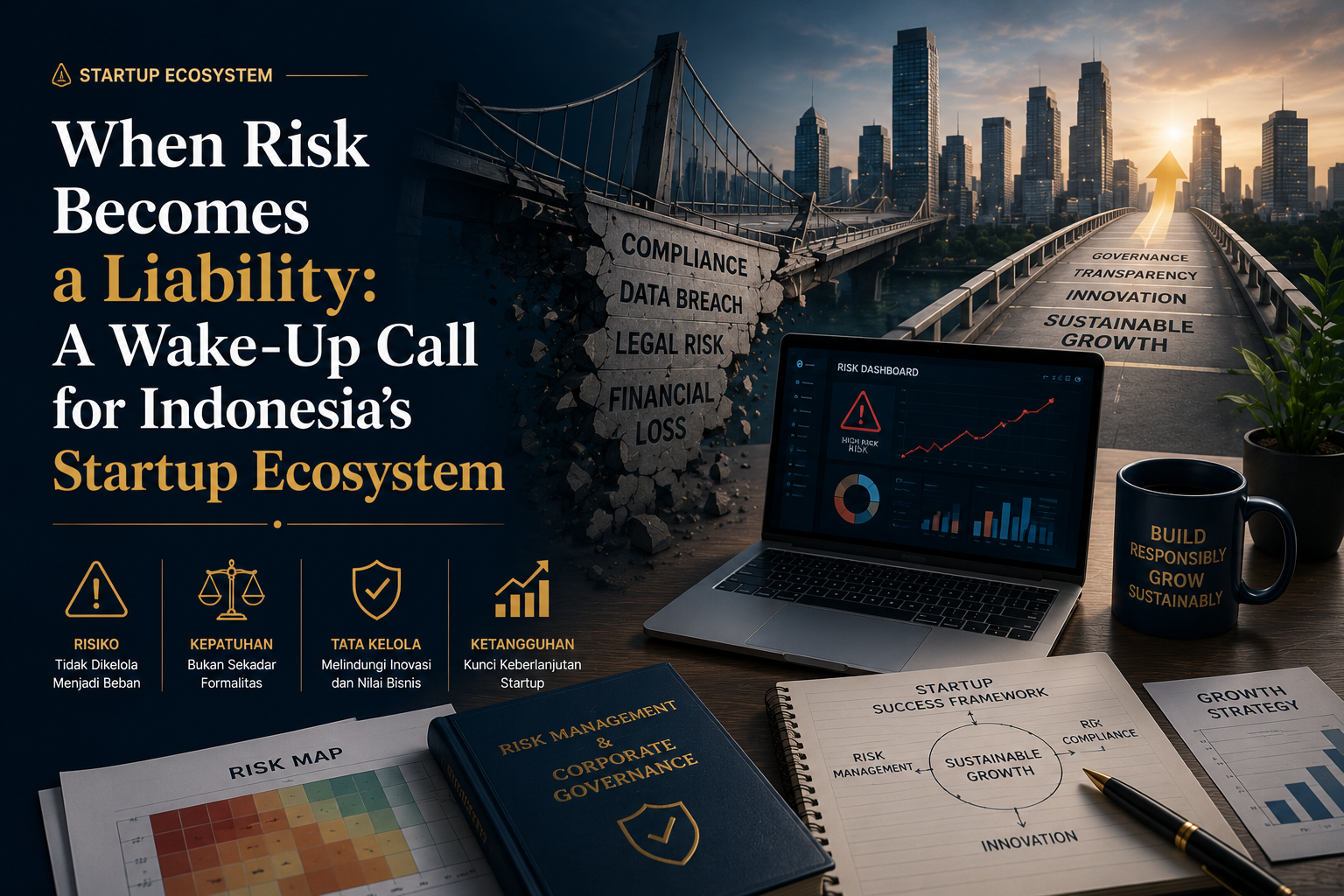
On June 18, 2026, the Jakarta Corruption Court (Tipikor) sentenced Donald Wihardja, former CEO of MDI Ventures, and Nicko Widjaja, former CEO of BRI Ventures, to prison terms, sending shockwaves through Indonesia’s venture capital sector and yet another chill through investment in Indonesia’s burgeoning tech economy.
In recent decades, venture capital has grown following a simple principle of high risk, high reward. With full awareness and confidence, venture capitalists pour money into startups, despite the high risk of failure compared to the potential for survival and great success. This tolerance is driven by the spirit of increasing innovation that has a broader impact on society. However, when business failure is interpreted as legal liability without clear parameters, it damages the very foundation of the venture capital business.
While this particular case may be showcasing an overzealous prosecutor cramming a case through Tipikor, it raises a fundamental question: when does risk—inherent in any investment—carry potential criminal liability?
Start-Ups & Their Dynamics
The recent flurry of venture capital investment from both foreign and domestic sources has spurred rapid growth in fintech and e-commerce start-ups, benefiting the community through job creation, expanded financial inclusion, and digital business transformation. Therefore, the venture capital business mechanism plays a significant role in Indonesia’s progress today, especially in governance, strategic support, and global network expansion.
Despite the positive impact of venture capital on innovation, the Jakarta Corruption Court’s verdict has a chilling effect on venture capitalists by blurring the line between investors and operators. Investors assess the viability of an enterprise but play only a limited role in ensuring the company’s success.
This certainly makes potential investors think twice about investing in Indonesia. The confidence of potential investors in Indonesia was immediately scorched by legal uncertainty in the country. The cratering of foreign investment touches all Indonesians, devaluing the rupiah and leading to skyrocketing inflation.
Legal Implications
The case itself and Tipikor’s jurisdiction is on shaky legal footing, given that there wasn’t even an allegation of fraud or self-enrichment by the Defendants. Whether or not the verdict holds up on appeal, however, is irrelevant; The bell warning investors to steer clear of investing in Indonesia can’t be “unrung.”
This vague criminal liability has serious implications for investors. First, investor wariness from start-up companies that are expected to grow will have difficulty obtaining funding from investors due to investor wariness to invest in companies that have not been proven to be successful and have high risk, followed by the shadow of ambiguous legal liability; Second, the innovation expected by the Indonesian government will be hampered, because there is an impression that tolerance for innovation failure no longer exists. Therefore, the hope of Indonesia becoming a developed country by encouraging innovations that impact society is difficult to realize; and Third, in the global landscape, capital flows that previously supported the development of Indonesian start-up companies will shift to other countries. This is inseparable from the grave concern over the lack of legal guarantees of protection for foreign investors themselves.
Legal Remedies
The Tipikor verdict against these individuals is just further evidence that Indonesia desperately needs legal reform that provides certainty of legal protection for investors. Any amendment must, of course, take into account the ecosystem of these start-up companies, especially interested stakeholders such as investors and operators.
Legal remedies, as stated above, must also be adaptive and capable of distinguishing reasonable business failures from deliberate violations. In line with this, the legal framework needed includes the limits of investors’ responsibility, the distinction between passive and active investors involved in management, strengthening the governance of start-up companies, including transparency and accountability mechanisms, and providing guidance on risk mitigation without impeding investment flows.
The Financial Services Authority (OJK), as a regulator, plays a strategic role in formulating legal reforms. Dialogue between the authorities, industry players, and other stakeholders must be the primary means of producing legal improvements that are responsive and adaptive to the industry’s development. The focus expected to be adopted by the OJK is to develop healthy business practices as a standard for doing business, as well as to increase law enforcement’s awareness of the dynamics of start-up companies.
Collectively, Tipikor’s verdict in this case should not be seen as a one-off case of punishing bad business judgment, but as a red flag for all of us to continuously improve the legal environment to support a conducive start-up ecosystem in Indonesia. With conducive legal support, start-up talent and entrepreneurship will grow and develop properly, and Indonesia will become a viable global investment destination. The way forward is not to choose between protecting investors and safeguarding the public interest. All it takes is finding the right balance. It is this balance that will determine whether Indonesia remains an attractive destination for venture capital—or vice versa. Wallahu’alam bis Showab – Budi & Chris
Budi Agus Riswandi
Guru Besar, Fakultas Hukum UII & Founder of Nusa IP
Christopher Cason
Dosen, Fakultas Hukum UII